 Welcome
to the Capybara Page
World’s Oldest Webpage about the World's Largest Rodent
Since 1998
Pages that are keeping up with capybara developments more regularly:
Capybaras in Japan - even if you can't read the words, the photos are great
Favorite new-ish things:
Official site of Japanese Kapibara-san
My article about Japan, capybaras, and me on Tofugu.com
A encounter with a rodent of unusual size in Texas.
Old Favorite Formerly New Things:
A story of capybara devotion from Rio.
Don't miss the perpetual capybara machine.
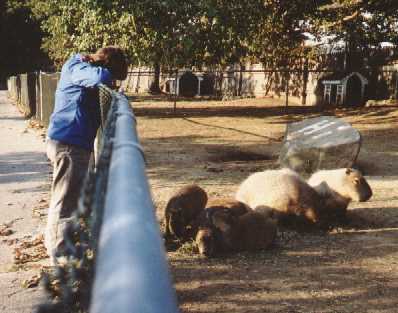 The capybara, Hydrochoerus Hydrochaeris, is a
semi-aquatic rodent of South America. It weighs about a hundred pounds, and is
about 2 feet tall at the shoulder. To help you imagine the size of a capybara,
click on the image to the right to see a picture including a human being (5 ft.
tall) for scale. The two capybaras on the right are adults, the rest are
juveniles.
The capybara, Hydrochoerus Hydrochaeris, is a
semi-aquatic rodent of South America. It weighs about a hundred pounds, and is
about 2 feet tall at the shoulder. To help you imagine the size of a capybara,
click on the image to the right to see a picture including a human being (5 ft.
tall) for scale. The two capybaras on the right are adults, the rest are
juveniles.
More or Less Frequently Asked Questions: Click here for a page of capybara facts
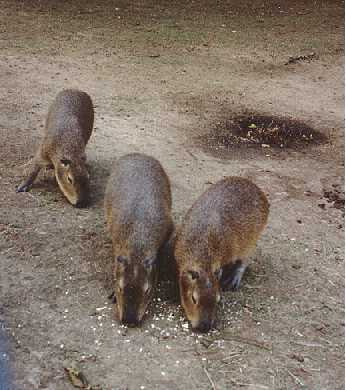
These pictures, including capybaras eating popcorn, were taken at Southwicks Wild Animal Farm in Mendon, Mass. (south of Worcester) which we recommend highly to the capybara-minded.
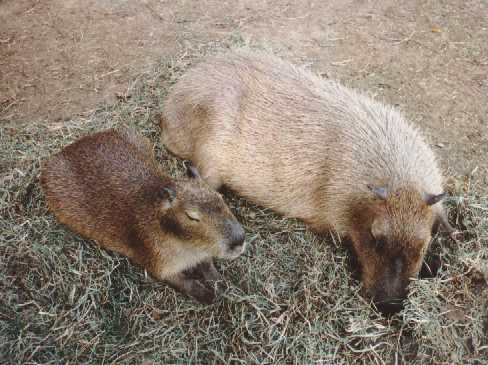
The next pictures show capybaras engaging in typical behaviors like nursing, swimming, and having their exhibit cleaned at the Montreal Biodome. By the way, "capybara" is stressed on the third syllable.
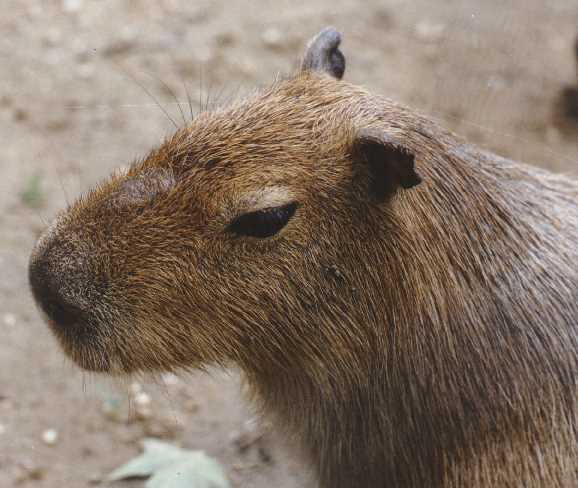
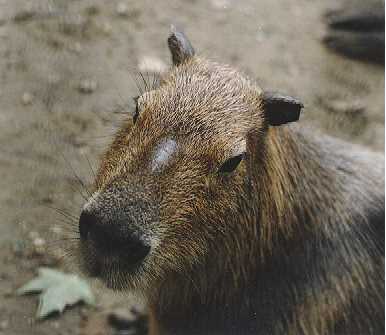 This picture of a
handsome male clearly shows the scent gland on his snout which he probably uses
to mark his territory (click to see a larger version).
This picture of a
handsome male clearly shows the scent gland on his snout which he probably uses
to mark his territory (click to see a larger version).
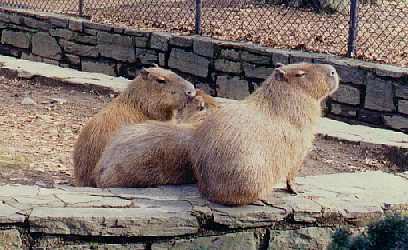
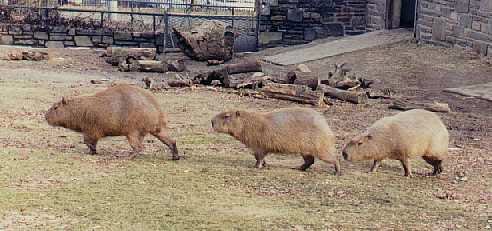
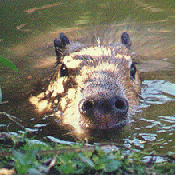
These pictures were taken at the Philadelphia Zoo.
Click on this picture for more photographs of capybaras living the good life in California...
And yet more pictures from:
Disney's Animal Kingdom - click here
Capybaras arriving at National Zoo, Washington, DC - unfortunately now they've left again, but click here for my fond memories of their arrival.
Kobe Zoo, Kobe, Japan - here
Reston Zoo, Virginia - click here

Capyboppy, a book written and illustrated by Bill Peet, published in 1966, is the true story of a capybara who actually lived with the Peet family. We highly recommend this book to any capybara fan. It is required reading for anyone who is considering trying out a capybara at home.
Quoted from The Mammals, A Guide to the Living Species by Desmond Morris, Harper & Row, New York, 1965:
Looking rather like a cross between a Guinea-pig and a Hippopotamus, the Capybara is the largest of all the I,729 species of living rodents. Extinct forms of this animal were even bigger, but the pig-sized, surviving specimens can reach an adult weight of more than IOO lb., an overall length of 4 feet and a shoulder height of 21 inches.
It lives in large groups along the river banks, where it grazes peacefully on the lush grasses and the aquatic vegetation. It comes out on to dry land to rest and bask in the sun but at the first hint of danger the whole troop dashes into the water. Its worst enemies are the Puma and the Jaguar.
Capybaras inhabiting the colder regions of South America have a long shaggy coat, but the typical form has the short, pale and rather coarse hair that can be seen in the above photograph. The face is very deep, the ears and tail are small and the feet are slightly webbed. There is a large bump in the middle of the top of the nose, which appears to be a scent gland of some kind.
Capybaras adapt easily to life in captivity and become remarkably friendly. They are rather vocal for rodents, often giving vent to a series of strange clicks, squeaks and grunts. It is important that they should be provided with a pool, as they appear to have a strong resistance to defecating or mating on dry land. The gestation period is approximately 4 months and maximum longevity about 1O years.
P.S.: Dr. Morris informs us that the capybara is his favorite rodent.
Click here for more information about capybaras in science and literature
Not for the Squeamish
We have read that capybaras may be eaten by Catholics during Lent in parts of South America, because they are aquatic. Fortunately, we have no pictures of this activity.
According to Emilio Herrera, a biologist and capybara
expert at Universidad Simon Bolivar in Caracas Venezuela:
"It is true that capybaras are eaten during Lent, but only in
Venezuela, and even there not everywhere. However, its dried
and salted meat is highly appreciated and is a traditional lenten dish. The annual capybara harvest is legal and
regulated by government. The well-designed management plan (based on a study by
Juhani Ojasti published in
1973) has been in operation for many years and is very successful, contributing
income to ranchers, meat for people, and not damaging their populations."
More on capybara meat (and other products ) here.
Find a Capy
Here is a list of zoos where you might be able to see capybaras, as reported by our readers, or which we've seen on our own visits, but this is several years old now and it is impossible to keep such a list up to date, so always phone ahead before visiting any zoo to avoid committing yourself to a wild rodent chase.
ISIS no longer has a search function available to the public but like me, you can keep forlornly checking back hoping they will restore it.
Submitted by other loyal capybara fans:

These beauties at the Tregembo Zoo in North Carolina were sent in by journalist Jefferson Weaver. More contributions:
- Wonderful letter and pictures
from Sao Paolo, Brazil, and a few more photos and emails sent in by fans,
in a disorganized list that I am thinking deeply about revising.
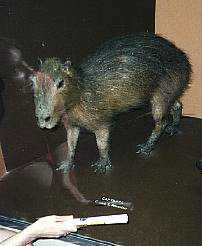
- Once again the only capybara in
Washington, DC (they have left the National Zoo due to reconstruction
of the elephant house), this stuffed guy is still in the renovated Hall of
Mammals, looking like it's barely been dusted off in all that shiny new
company.
- The Call of the Capy
A sound clip sent by BSweet who
also has video footage of the capys in
Springfield. If you are interested, you can drop him a line.
- A capybara in a canoe. This
picture is so good it needs its own link.
Capybaras on the Loose:
- Some reports of capybaras in the wild in the US that
have been sent to me are here.
A few more capybara links:
- Capybara Music: The link about the old musical group
The Cappy Bara Boys has vanished, so I give you
instead Capybara by Shonen Knife.
- Click here
for some remarkable capybara pictures, but only if you think you can
resist the temptation to want a pet capybara even after seeing a picture
of a baby capy wearing a bib. We really don't
want to be encouraging people to think capybaras make good pets.
- Click here for
a site that sells capybaras. We include this information because we do get
asked... but please be responsible in all your
animal purchases, OK? A good resource for how much work it is to own your
own capybara is Caplin Rous' pages linked to up
at the top.
- A nightmare a
capybara might have

Shopping:
· Buy lovely capybara buttons and magnets (other good animals too)
· Wonderful capybara print by Will Bullas
Contact: 
Last updated 7/26/14